
What is an Acoustic Neuroma (Vestibular Schwannoma)?
An acoustic neuroma (also known as vestibular schwannoma) is a benign (noncancerous) brain tumor that develops on vestibular nerve, which controls balance and hearing. While acoustic neuromas do not spread to other parts of the body, they can grow over time and cause symptoms by pressing on nearby nerves or brain structures, sometimes requiring treatment.
Who Is Most Likely to Develop an Acoustic Neuroma?
Acoustic neuromas are most often found in adults between 30 and 60. Because they grow slowly, they’re often discovered by accident during imaging for another issue. In most cases, the tumor appears on only one side, but people with the rare genetic condition Neurofibromatosis Type 2 may develop tumors on both sides.
How is Acoustic Neuroma Treated?
There are two primary treatment options for acoustic neuroma surgery – traditional surgery, and Gamma Knife radiosurgery, a specialized form of radiation therapy. Each approach has distinct benefits and risks, and in some cases, both treatments may be used together. Depending on several factors such as the size of the tumor, growth rate, and location, your doctor will recommend the approach they feel is most appropriate in your case.
Gamma Knife Radiosurgery for Acoustic Neuroma
Gamma Knife radiosurgery is not a traditional surgical procedure and involves no incisions. It is an advanced form of radiation therapy that uses multiple focused beams to target treatment directly at your tumor, sparing the healthy surrounding brain tissue. There is no hospital stay and fewer unpleasant side effects than with traditional radiation therapy.
Traditional Surgery for Acoustic Neuroma
In traditional surgery, your neurosurgeon will access the tumor and remove as much as possible. The surgery is performed using anesthesia in a hospital setting and does require a hospital stay. Sometimes, surgery may be followed up with Gamma Knife radiotherapy in a combination approach to eliminate any remaining tumor cells.
When to Choose Gamma Knife vs. Surgery
Based on the size and location of your acoustic neuroma tumor, as well as your specific health factors, your doctor will recommend the treat option they feel is best for you. However, there are some instances in which doctors commonly favor one approach over the other.
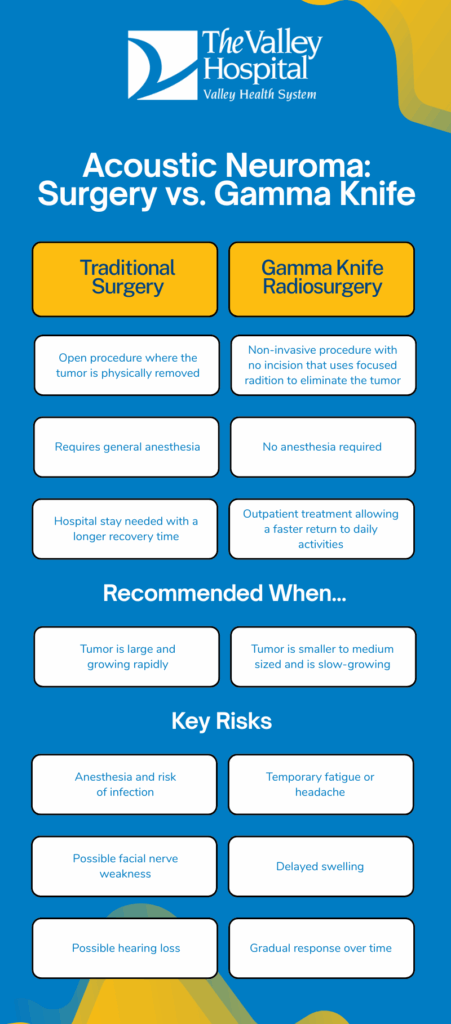
If your tumor is very large, surgical resection may be the preferred approach, as Gamma Knife alone may not remove the tumor cells. Likewise, surgery is sometimes the preferred approach for younger patients.
However, some patients are not good candidates for surgery due to age, complicating health conditions, or other factors, in which case minimally invasive Gamma Knife radiosurgery will likely be the initial treatment approach.
What are the Benefits & Risks of Acoustic Neuroma Treatment?
As your doctor develops your treatment plan, they will consider the risks and benefits of each option relative to your individual condition to determine the most appropriate treatment path for you.
Benefits and Risks of Gamma Knife Radiosurgery
Benefits:
- Minimally invasive procedure, with no incisions
- Less pain and shorter recovery time than traditional surgery
- No hospital stay required
- No risks are commonly associated with surgery, including anesthesia reactions and infection
- Available when a patient cannot undergo traditional surgery
Risks:
- Side effects associated with radiation therapy, including headache, nausea and fatigue
- Risk of delayed swelling months later (treatable with medications)
Benefits and Risks of Acoustic Neuroma Surgery
Benefits:
- Once surgeons remove a tumor, recurrence is unlikely
- If complete resection is not possible, can combine with Gamma Knife radiosurgery
Risks:
- Risks associated with any surgical procedure, including anesthesia reactions and infection
- Risk of damage to the facial nerve, resulting in temporary or permanent muscle weakness
- Risk of damage to the vestibulocochlear nerve, affecting hearing
- Hospital stay required
- Longer healing time with more discomfort than Gamma Knife radiosurgery